







Past Events
Galactosemia Association of the North Eastern States, Inc.
Get-Together: An Evening with Ray and the Researchers"
Friday, October 1, 2004, 7:00-9:00pm
Children's Hospital of Philadelphia
Agenda:
- Welcome and GANES Update - Angie Forsyth and Chris DePhillipo
- Living with Galactosemia: An Adult Perspective - Ray Mansfield
- Current Research and Galactosemia Update - Dr. Segal and Dr. Berry
- Time for questions and to meet & share experiences with others
The meeting began at 7:40 p.m.
This program was attended by 36 adults and 16 children. Included were 11 individuals with classic galactosemia, parents, grandparents, siblings, friends and health care professionals. All four GANES officers and two regional representatives were present. Attendees represented the following locations: Delaware, New Jersey, New York, North Carolina, Oregon, Pennsylvania, and Ontario, Canada.
Welcome: Angie Forsyth, President of GANES gave an introduction and overview of tonight?s agenda. Angie introduced the officers of GANES present at the meeting; Angie Forsyth, President; Jane VanZandt, Vice President; Maureen Bell, Secretary and Mike Denny, Treasurer. Angie touched on the formation, purpose and intent of the GANES organization.
Opening: Chris DePhillipo introduced himself and his wife Lynne and their three-year-old daughter Gabriella. Chris is working on the GANES website and expects to have it up and running in a week or so. He is hoping to be able to have parents post recipes, so please get ready to send them in. Chris created this website with growth in mind to one day be a national website. He would like it to include contact information for galactosemia, GANES information, meeting information, and anything else that can forward the interest and education for galactosemic parents and patients alike.
Living with Galactosemia:
Ray Mansfield introduced himself and his wife Janet. They are from Oregon and he is here participating in a research project with Dr. Berry and Dr. Segal as an adult galactosemic. This get together was designed as a way for Ray to meet other families and for our families to meet Ray.
Ray urged more adults to get involved with the research efforts. He is currently 41 years old and has had trouble with the following issues which may or may not be directly linked to Galactosemia: he was sick at birth and loosing weight, he had trouble with coordination in school, trouble with math and reading, cold hands and feet, auditory processing disorder, poor motor planning, impulsivity, tremors, migraines and in 2001 he lost some feeling on his left side. He is glad to be here and to be part of the research. He is tired from all the testing but reminded us how important it is for the doctors to be able to continue to understand this disease. He explained galactosemia this way: He said "it is like I am standing on a busy road and the cars are going by and I know I have to get to the other side of the street but I just don't know how to do it".
Current Research:
Maureen Bell is a 32 year old with galactosemia. She introduced Dr. Gerry Berry as her treating physician and as someone she admires for all of his efforts on behalf of galactosemia as well as his empathy to all of his patients. Maureen has also been involved as a participant in research projects over the years for Dr. Berry.
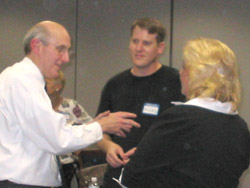 Dr. Gerard Berry spoke and introduced Dr. Stan Segal as the Director of Galactosemia Research and he also introduced Dr. Can Ficicioglu as a new member of the metabolic team at Children's Hospital.
Dr. Berry touched on the neurological problems associated with galactosemia. At the newborn stage the babies are lethargic. Research is not clear whether this affects the brain. From 18-36 months there may be the first signs of developmental delays such as verbal dyspraxia. This would indicate some central nervous system malfunction. In school, children may have problems with math, figures in space and reading. These problems may lessen if the appropriate special instruction is given. By the teenage years, there are no new appearances of problems. A small minority of individuals experience tremors. This usually exists by itself. The most feared complication is ataxia dystonia syndrome that is the part of the brain that controls the motor functions and coordination. A person may walk unsteady or have motor problems but this affects less than 10-15% of patients.
However, it is not clear what causes these problems or their origin. There is the possibility of exposure during the first few days/weeks of life. Galactose levels even on a restrictive diet could predispose individuals to future problems. There are just no clear answers. In the 1st - 2nd years of life there are white matter differences in the brain that can be depicted with an MRI. Is it a real injury? Doctors are not certain. There is much more worked needed to be done to understand the function of a brain of a child with galactosemia.
Dr. Stanton Segal spoke and gave some background of his years as a researcher. In 1955 he saw his first galactosemic patient. The first case reported in literature is in 1935 at the National Institute of Health. Dr. Segal came to Children's Hospital of Philadelphia in 1966 to set up research for galactosemia. He set up a training program and Dr. Berry was one of his first trainees.
Dr. Segal touched on the significance of galactose. There are ways that galactosemics can metabolize galactose (oxidize). Galactosemics make galactose and not a small amount either. Our bodies need galactose to make membranes and cells in the brain. There is a balance in the body, how much galactose you produce and how much your body metabolizes.
Dr. Segal spoke about the lab project. A mouse with galactosemia ("Knock Out" Mouse) doesn't get sick. Why? Even with the same enzyme and gene defect, the mice still don't get sick. There may be new approaches to therapy if the doctors can find out why the mice don't get sick. The diet (elimination of certain foods) is not always effective. What else is going on even with the lack of the enzyme? Dr. Segal said there is consideration for gene therapy on these mice.
Clinical Investigation: Dr. Segal said there have been patients who have participated in the research to help them understand how an individual's metabolism functions. NIH funded a project to see what pathway may exist in the galactosemic patient to metabolize galactose. If we know the pathway, can we devise another approach to therapy? We are looking for a complete balance. Dr. Segal is hoping to do research on 16 galactosemic patients. He needs children over the age of 10 to participate and this will be ongoing research for the next two years.
Brain Study: Dr. Segal said that Maureen Bell and Ray Mansfield underwent a PET scan (Positron Emission Tomography) which is a new technique that may not be available everywhere. The PET scan takes pictures of the brain with a compound and it gives you metabolic information. It can take pictures of the centers of the brain showing metabolism. This is a great resource to show what is going on in the brain. Currently Dr. Segal is applying for a grant from NIH for monitoring galactosemia. He would like to be able to give a patient small amounts of galactose over a 2 week period and do a scientific evaluation to see what the person can ingest before any changes occur. Diets do vary and what should a person's diet be? Research would only help better understand this question.
Q & A Session:
Q: "Does galactose affect the baby in the womb or early years and if so, if there is damage to the brain, do children grow past it?"
A. Dr. Berry: "There is a good possibility, data does suggest the brain can recover from an insult but with galactosemia, we really can't say."
A. Dr. Segal: "Whether in-utero or post - galactose can damage the brain and galactose being made can cause problems as well. We are hoping to have an answer through the mice. Also, PET scan and MRIs can be done for free for research purposes for patients over the age of 18 (because of the radioactivity). For the metabolic studies you need to be over the age of 10 because you receive a small dose frequent dose of Tylenol."
Q: "Are there any side affects to the studies?"
A. Dr. Segal: "None known."
 Closing: Angie once again thanked Ray, Dr. Berry and Dr. Segal for taking the time to be with us tonight and to share their thoughts, expectations and continued research ideas. Angie reminded everyone to make sure they signed in and to also complete the program evaluations. It was a great night with a great turnout and the speakers gave everyone a little more insight to understanding how galactosemia affects our lives and ways we can try to better understand it.
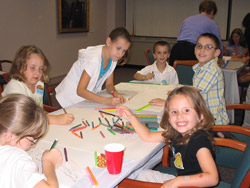
All attendees had the opportunity to meet informally before and after the program. The refreshments were sponsored by GANES, Trader Joe's, and Tofutti. Child care and fun activities were provided by volunteers during the meeting.
The meeting was adjourned at 9:20 p.m.